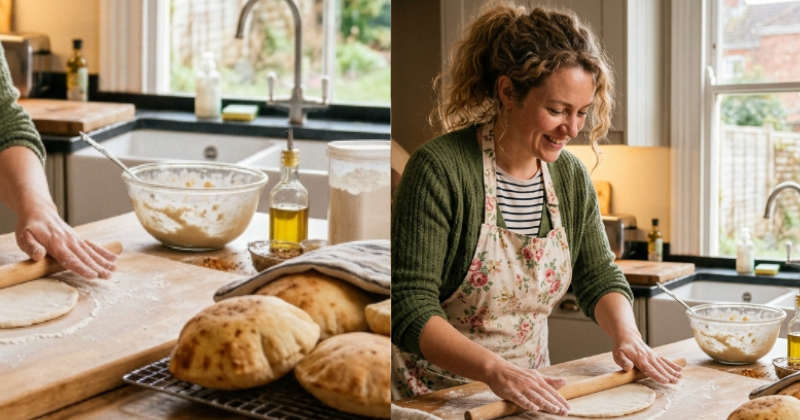
There is a smell that takes me straight back to a kitchen that was never entirely quiet. My friend Layla’s mother baked khubz every morning before the rest of the neighborhood had woken up — the dough already risen by the time the call to prayer faded, the oven already hot, the first rounds already puffing and blistering before anyone had thought about breakfast. She never measured. She said the dough would tell you when it was ready, and she was right in the way that people who have made something ten thousand times are always right. Authentic Arab bread recipes are among the most important baking traditions I have ever been invited into, and these five — each one distinct, each one connected to a region, a table, a particular way of eating — are the ones worth learning before any other bread.
Why These Recipes Feel Like Home
Khubz, in its many forms, is not merely bread. It is the vehicle through which everything else is eaten.
- It is soul-warming in a way that goes beyond the bread itself. A fresh round of khubz pulled from a hot oven and set on the table transforms a simple meal of hummus, labneh, and olives into something that feels complete and generous.
- It is timeless. Arab flatbread has been baked in essentially the same way for centuries — the same flour, water, yeast, and salt, shaped by hand, cooked on extreme heat, eaten immediately.
- It is the kind of bread people ask for again and again — not because it is complicated, but because homemade khubz, still warm and slightly charred at the edges, is so much better than anything that comes pre-packaged that there is no real comparison.
- It brings people together around the table in the most literal sense. Arab bread is torn, shared, dipped, and passed. It is the act of the meal as much as the food itself.
The Ingredients That Tell the Story
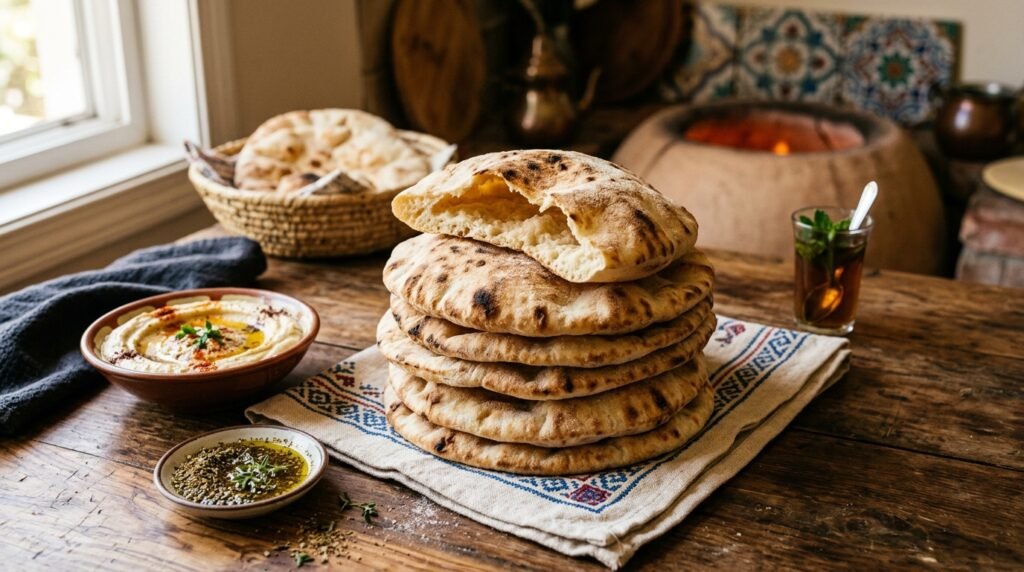
Arab bread recipes in all their variations are built from the same humble foundation. The differences lie in the ratios, the additions, and the method of cooking.
All-purpose or bread flour: The base. Bread flour, with its higher protein content, produces more gluten development and a chewier, more pliable bread — better for pita and khubz. All-purpose flour works and produces a slightly more tender result. Some recipes blend the two. Whole wheat flour can replace up to half the all-purpose for a nuttier, denser bread that is more nutritious and slightly less pliable.
Active dry yeast or instant yeast: The lift. Active dry yeast must be proofed in warm water before using; instant yeast can go directly into the dry ingredients. Either works. Fresh yeast, used in traditional recipes, produces a more complex flavor — use 3 times the weight of fresh yeast compared to dry if you can find it.
Warm water: The hydration that activates the yeast and brings the dough together. The temperature matters — between 100°F and 110°F. Too hot kills the yeast. Too cold and it will not activate properly. The water should feel like a comfortable warm bath, not hot.
Salt: Structure, flavor, and fermentation control. Added to the flour, not to the yeast water — direct contact between salt and yeast can inhibit activation. One teaspoon per two cups of flour is the baseline.
Olive oil: Used in several of the five recipes, not all. When present, it adds suppleness to the dough and a richness to the finished bread. The flatbreads that do not include it — like basic khubz and pita — achieve their character through simplicity.
Sugar or honey: A small amount to feed the yeast and encourage browning. Half a teaspoon in the proofing water is enough. The bread should not taste sweet.
Semolina flour: Used as a dusting agent in several recipes and as a component of the dough in others. It adds a slight graininess and prevents sticking without absorbing as much moisture as all-purpose flour does when used for dusting.
Za’atar, sesame seeds, nigella seeds: The toppings and additions that define regional variations. Za’atar mixed with olive oil becomes manaqeesh. Sesame seeds sprinkled over ka’ak biscuits are as traditional as the bread itself.
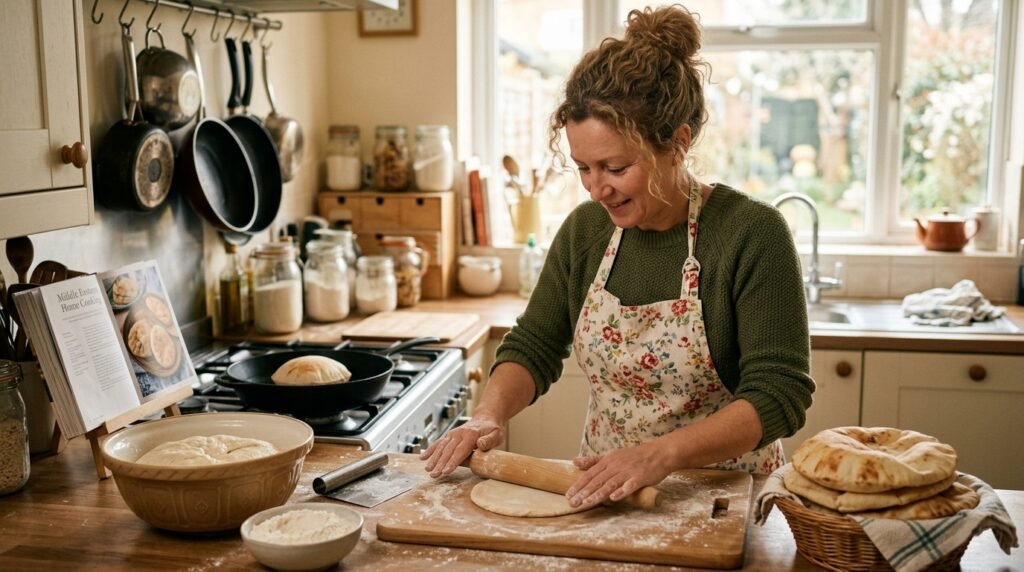
Step-by-Step Instructions: 5 Authentic Arab Bread Recipes
Bread 1: Classic Khubz (Arabic Flatbread)
Prep time: 20 minutes | Rise time: 1 hour | Cook time: 3 minutes per round | Total time: ~1 hour 30 minutes | Makes: 8 rounds
Ingredients:
- 3 cups (360g) bread flour, plus more for dusting
- 1 teaspoon instant yeast
- 1 teaspoon salt
- 1 teaspoon sugar
- 1 cup plus 2 tablespoons warm water
- 1 tablespoon olive oil
- Combine flour, yeast, salt, and sugar in a large bowl and whisk briefly to distribute everything evenly. Make a well in the center.
- Add the warm water and olive oil to the well. Mix with your hand or a wooden spoon until the dough comes together into a shaggy mass.
- Turn onto a lightly floured surface. Knead for 8 to 10 minutes until the dough is smooth, elastic, and springs back when pressed. This is the part that cannot be rushed — the gluten development that happens here is what makes the bread pliable rather than brittle.
- Place in a lightly oiled bowl, cover with a clean kitchen towel, and leave to rise in a warm place for 1 hour until doubled in size.
- While the dough rises, place a baking stone or heavy sheet pan in the oven and preheat to 500°F — the highest temperature your oven will reach. Let it preheat for at least 30 minutes. The intense heat is what makes khubz puff.
- Divide the dough into 8 equal pieces. On a lightly floured surface, roll each piece into a round about 7 inches in diameter and 1/8 inch thick. Let the rounds rest for 10 minutes on a floured surface — this relaxation allows them to maintain their shape in the oven.
- Working in batches, slide 2 to 3 rounds onto the hot baking stone using a flat sheet or pizza peel dusted with semolina. Bake 3 to 4 minutes until puffed and lightly golden. They should balloon dramatically in the heat. You will know they are ready when the tops are just beginning to color and the whole round looks like a pillow.
- Remove and wrap immediately in a clean kitchen towel — the steam trapped inside continues to cook the bread gently and keeps it soft.
Bread 2: Pita Bread with Pockets
Prep time: 20 minutes | Rise time: 1 hour 30 minutes | Cook time: 3 minutes per round | Total time: ~2 hours | Makes: 8 pitas
Ingredients:
- 3 cups (360g) all-purpose or bread flour
- 2 teaspoons instant yeast
- 1 1/4 teaspoons salt
- 1 teaspoon sugar
- 1 cup warm water
- 2 tablespoons olive oil
- Mix all dry ingredients. Add water and oil. Knead 8 minutes until smooth and supple.
- Rise covered for 1 hour until doubled. Then divide into 8 balls. Rest 20 minutes — do not skip this; the resting relaxes the gluten and makes rolling significantly easier.
- Roll each ball into a round 6 to 7 inches across and uniformly 1/4 inch thick. Uniform thickness is critical — an uneven round produces uneven puffing and a pocket that forms on one side only.
- Bake on a preheated stone or pan at 500°F for 3 minutes. The pocket forms from the steam trapped between the two layers of dough — it only forms if the dough is thin and even and the oven is genuinely hot.
- Stack in a towel as they come out. The moisture they release into each other keeps them soft and pliable.
Bread 3: Manaqeesh (Za’atar Flatbread)
Prep time: 20 minutes | Rise time: 1 hour | Cook time: 8 minutes per round | Total time: ~1 hour 30 minutes | Makes: 6 large rounds
Ingredients:
For the dough:
- Same as classic khubz above
For the za’atar topping:
- 4 tablespoons dried za’atar (the herb blend, not just thyme)
- 4 tablespoons good olive oil
- Pinch of salt
- Make the dough and allow it to rise as in the classic khubz recipe.
- Mix za’atar and olive oil into a spreadable paste. Taste it. It should be herby, slightly sharp, and rich with olive oil. This is one of the most important flavor combinations in the Arab pantry — use the best olive oil you have.
- Preheat oven to 475°F with a baking stone inside.
- Divide dough into 6 pieces. Roll each into a round about 8 inches across.
- Spread a generous tablespoon of the za’atar mixture over each round, leaving a small border at the edge.
- Bake for 7 to 8 minutes until the edges are golden and the za’atar is fragrant and slightly darkened. The kitchen will smell extraordinary. This is not an exaggeration.
- Serve warm, folded in half, with labneh and cucumber alongside.
Bread 4: Taboon Bread (Thick Flatbread with Charred Spots)
Prep time: 20 minutes | Rise time: 1 to 2 hours | Cook time: 10 minutes per round | Total time: ~2 hours | Makes: 6 rounds
Ingredients:
- 3 cups (360g) bread flour
- 2 teaspoons instant yeast
- 1 1/4 teaspoons salt
- 1 teaspoon sugar
- 1 cup warm water
- 2 tablespoons olive oil
- Sesame seeds and nigella seeds for topping (optional)
- Make and rise the dough as above. Taboon is thicker than khubz — divide the dough into 6 pieces and roll each to about 3/4 inch thickness rather than thin.
- Traditional taboon is baked in a clay oven on a bed of small stones that create the characteristic charred indentations. At home, use a cast iron skillet or a very hot baking stone.
- Heat a cast iron skillet over the highest flame your stove has for 5 full minutes. The pan should be almost smoking.
- Place a round of dough in the dry skillet. Cook 4 to 5 minutes until large bubbles form and the bottom is charred in spots. Flip and cook 4 minutes more.
- Sprinkle sesame and nigella seeds over the surface during the last minute of cooking. They will toast in the pan’s heat.
- Wrap in a towel. Taboon is the bread for musakhan — chicken roasted with caramelized onions and sumac — and it is worth making for that purpose alone.
Bread 5: Ka’ak (Arab Ring Bread with Sesame)
Prep time: 25 minutes | Rise time: 1 hour | Cook time: 20 minutes | Total time: ~1 hour 50 minutes | Makes: 12 rings
Ingredients:
- 3 cups (360g) all-purpose flour
- 1 teaspoon instant yeast
- 1 teaspoon salt
- 1 tablespoon sugar
- 1/2 cup warm water
- 1/4 cup warm milk
- 3 tablespoons olive oil or melted butter
- 1 teaspoon mahlab (ground cherry pits, optional but traditional)
- 1 teaspoon anise seeds, lightly crushed
- 1/2 cup sesame seeds for coating
- 1 egg, beaten (for egg wash)
- Combine flour, yeast, salt, sugar, mahlab, and anise. Add water, milk, and oil. Mix and knead 8 to 10 minutes until smooth.
- Rise 1 hour covered. The dough will not double as dramatically as the flatbreads — it is slightly denser by design.
- Preheat oven to 375°F. Line two baking sheets with parchment.
- Divide dough into 12 equal pieces. Roll each into a rope about 10 inches long. Join the ends to form a ring and press firmly to seal.
- Brush each ring with beaten egg. Press into the sesame seeds so the entire surface is coated.
- Place on prepared sheets and bake 18 to 20 minutes until deeply golden and the sesame seeds are toasted. The rings should feel firm all the way through when tapped on the bottom.
- Ka’ak keeps well — stored in an airtight container, they last three to four days and are excellent for breakfast with tea.
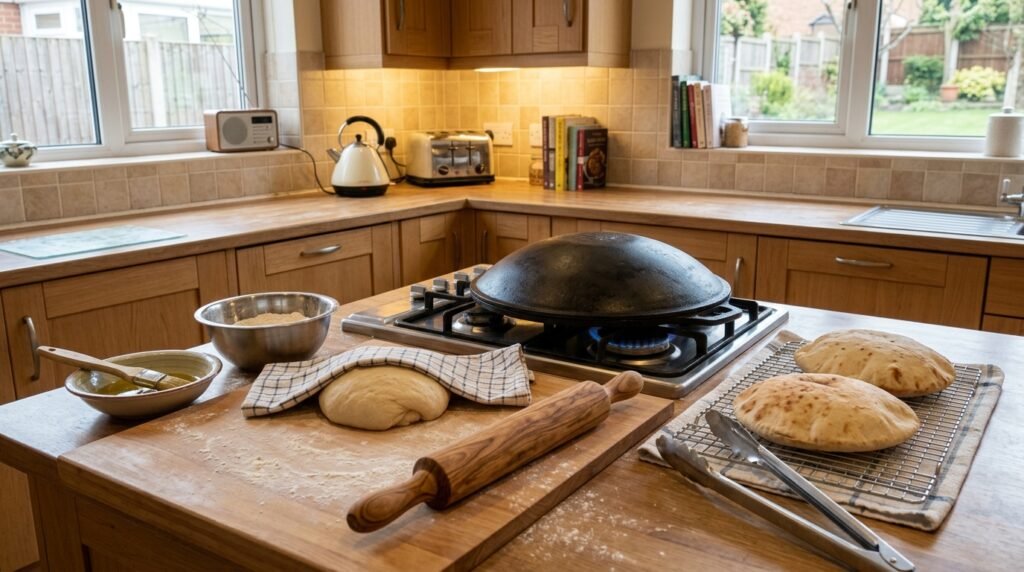
Tips Passed Down (and Hard-Earned)
The oven must be genuinely hot. For khubz and pita to puff properly, the oven needs to be at its maximum temperature and the baking surface needs to have been preheating for at least 30 minutes. A lukewarm oven produces flatbread that is cooked through but never puffs — edible but not the same thing. Allow more preheat time than you think you need.
Here is what took me years to figure out: the dough rounds must rest before going into the oven. After rolling, cover them and let them rest for 10 to 15 minutes. During this rest, the gluten relaxes and the rounds stop trying to spring back. They will be easier to slide onto the baking surface and will puff more evenly.
Wrap the bread immediately as it comes out. This is not a suggestion. The steam released from hot bread, if allowed to escape into the air, produces bread that is dry and brittle within minutes. Stack the rounds in a clean towel and fold it over them. They will stay soft for hours.
Do not roll the dough too thin or too thick for pita. Too thin and it will not have enough structure to form a pocket. Too thick and the layers cannot separate under the steam pressure. Aim for a consistent 1/4 inch throughout — use a rolling pin and take the time to get it even.
Here is the family secret, such as it is: Layla’s mother always added a tablespoon of yogurt to the khubz dough. She said it made the bread softer and gave it a slight tang that plain water never could. A tablespoon of full-fat yogurt in place of an equivalent amount of water in any of these recipes produces a more tender crumb and a flavor that is subtly more complex.
Do not add too much flour when kneading. The dough should feel slightly tacky but should not stick to your hands — sticky enough that you know it is hydrated, dry enough that you can work with it. Adding too much flour produces stiff bread that does not puff properly and tears rather than folding.
How to Serve It (and Who to Serve It To)
Classic khubz belongs at every table that has hummus, labneh, baba ghanoush, or ful medames. It is the vehicle, and these dishes are not complete without it.
Pita is the bread for stuffing — falafel, shawarma, grilled chicken thighs with garlic sauce. Split it carefully and fill generously.
Manaqeesh is breakfast food in the Levant, and it should be in your breakfast rotation too. Serve it warm, with labneh thick enough to spread and sliced cucumber and tomato alongside. A small glass of sweet tea or Arabic coffee is the right companion.
Taboon is made to be eaten with musakhan — the Palestinian national dish of chicken roasted with onions, sumac, and pine nuts over layers of taboon bread that soak up every drop of the cooking juices. Make both or make the bread alone and eat it with olive oil and za’atar.
Ka’ak is a bread that belongs in a basket, alongside morning coffee or tea. Set it out and let people eat it throughout the morning. It is not a meal bread — it is a companionable bread, the kind that makes a cup of tea feel more complete.
Why It’s Good for You Too
These authentic Arab bread recipes are built from simple, whole ingredients without preservatives, additives, or anything that would not have been in a kitchen a hundred years ago. The bread you make at home is genuinely different from what comes in a plastic bag at the grocery store, and not just in flavor.
Bread flour and all-purpose flour both provide complex carbohydrates and a meaningful amount of protein. Whole wheat flour substitutions in any of these recipes increase fiber and mineral content — up to half whole wheat in any recipe produces a bread that is more nutritious and only slightly denser.
The olive oil in many of these recipes provides monounsaturated fat that is among the most studied and documented healthy fats in the world. The quantities used per serving are modest.
For a dairy-free version of the ka’ak, substitute warm water for the milk. The texture changes slightly — a little less tender — but the rings are still good and the flavor of the mahlab and anise comes through clearly.
All five of these recipes are naturally vegan as written with the exception of the egg wash on the ka’ak, which can be replaced with a plant-based milk wash for a similar browning effect.
Questions Readers Always Ask
Why won’t my pita puff? The most common reason is an oven or baking surface that was not hot enough. The puffing happens when steam forms rapidly between the two layers of dough — this requires intense heat and a very hot baking surface. Preheat your stone or pan for at least 30 minutes at the highest temperature your oven allows. The second most common reason is uneven thickness — roll carefully and evenly.
Can I make these doughs ahead of time? Yes. After the first knead, the dough can be placed in an oiled container, covered tightly, and refrigerated for up to 24 hours. The cold temperature slows the yeast and produces a slightly more complex flavor through the longer fermentation. Bring the dough to room temperature for 30 to 45 minutes before shaping and baking.
How do I store leftover bread? Khubz, pita, and manaqeesh are best eaten the day they are made. If you have leftovers, store them in a sealed plastic bag at room temperature and refresh them by wrapping in a damp towel and warming in a 350°F oven for 5 minutes. Ka’ak stores well at room temperature in an airtight container for three to four days. All of these breads freeze well — wrap each round individually in plastic and freeze for up to two months. Defrost at room temperature and warm before serving.
What is mahlab and where do I find it? Mahlab is the ground pit of a specific variety of wild cherry and produces a faintly almond-like, slightly bitter flavor that is characteristic of many Levantine and Middle Eastern baked goods. It is available at Middle Eastern grocery stores, some specialty spice shops, and online. If you cannot find it, omit it from the ka’ak recipe — the bread will be good, just less distinctively traditional.
These 5 authentic Arab bread recipes are an invitation into a baking tradition that is both ancient and alive — one that rewards patience, practice, and a genuinely hot oven. Start with the classic khubz. Make it twice. Then move to the pita and the manaqeesh. Serve them while they are warm, with generous accompaniments and people you want to sit with. The bread will be different every time you make it, and better every time too — adjust it, learn it, and eventually make it your own.