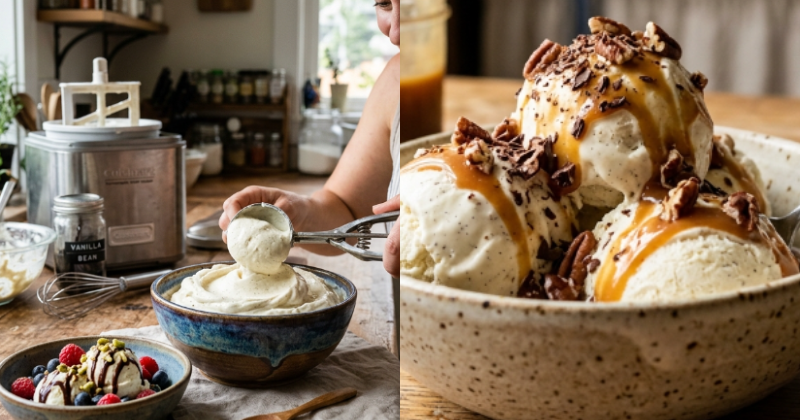
7 Genius Ice Cream Recipes Holiday Guests Will Obsess Over — Frozen Desserts Worth the Effort
The holidays need a dessert that holds. Ice cream recipes made well do exactly that — prepared days ahead, pulled from the freezer at the right moment, served without panic.
These seven ice cream recipes for holiday gatherings cover the full range of the season: spiced, boozy, dark, bright, and quietly elegant. Each one is built to impress without requiring you to be present in the kitchen when guests arrive. That is the point.
Prep Time: 20–30 minutes | Churn/Freeze Time: 4–8 hours | Total Time: 5–9 hours | Servings: 6–10 per recipe
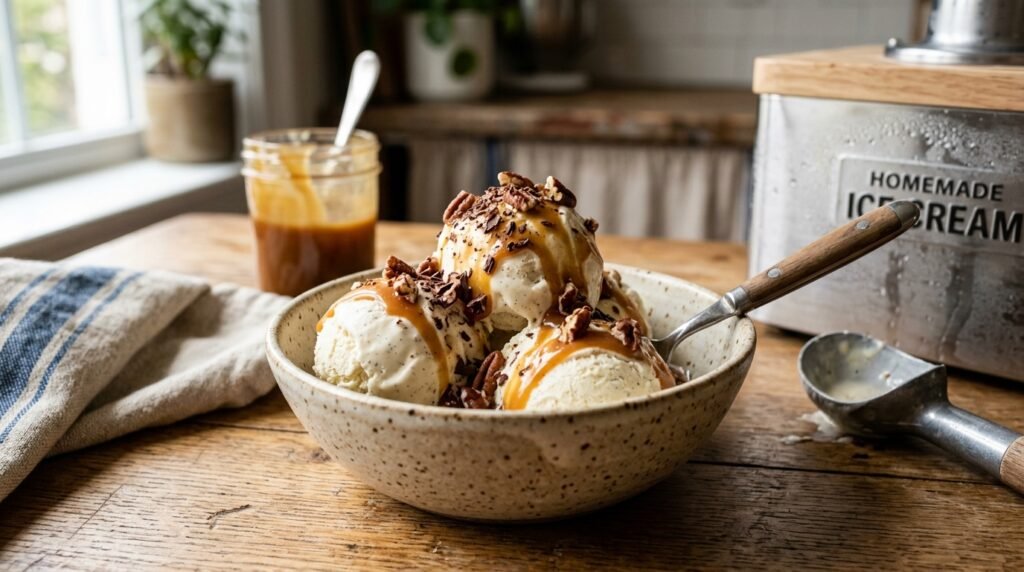
What Makes It Worth Making
- Ice cream made at home contains no stabilizers or emulsifiers. The texture is noticeably different — denser, cleaner, more direct.
- Every recipe here can be made 3 to 5 days ahead. The freezer does the work. You do not.
- The custard base is transferable. Learn it once and every flavor variation on this list follows without a new technique.
- Cold desserts read as considered. A well-made ice cream on a holiday table signals effort without announcing it.
The Ingredients
Custard base (applies to all egg-based recipes):
- Whole milk (240ml): The liquid component of the custard. Do not substitute low-fat milk — the reduced fat content produces an icier, less smooth result.
- Heavy cream (480ml, cold): The fat that gives ice cream its texture and body. Higher fat content means a creamier, slower-melting result. This is not the place to reduce.
- Egg yolks (5 large): The emulsifiers. They bind fat and water into a stable custard that churns into a smooth, scoopable texture. Room temperature yolks incorporate more evenly than cold ones.
- Granulated sugar (150g): Dissolved into the yolks. Sugar also lowers the freezing point of the mixture, which is part of what keeps the finished ice cream soft enough to scoop straight from the freezer.
- Fine sea salt (pinch): Present in every recipe. It suppresses bitterness and sharpens every other flavor in the base.
- Pure vanilla extract or vanilla bean paste (1 teaspoon): Background. It rounds the custard without dominating it. Vanilla bean paste produces visible specks — a visual cue that signals quality.
No-churn base (for recipes 6 and 7):
- Heavy cream (600ml, cold): Whipped to stiff peaks. The air incorporated during whipping replaces the mechanical aeration of an ice cream machine.
- Sweetened condensed milk (397g, one standard tin): Provides sweetness and a smooth, stable texture without an ice cream machine. The sugar content keeps it soft in the freezer.
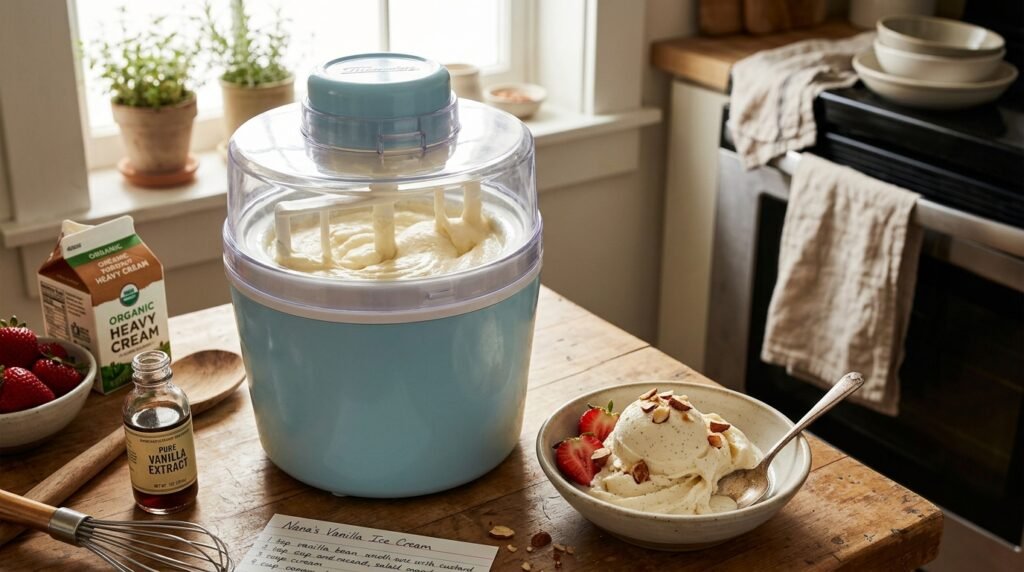
How to Make It
Master Custard Base (Applies to Recipes 1–5)
- Combine milk and half the cream in a medium saucepan over medium heat. Warm until steam rises and small bubbles form at the edges — do not boil. Remove from heat.
- Whisk egg yolks and sugar in a bowl until pale and slightly thickened, about 2 minutes.
- Temper the yolks. Add the warm milk mixture slowly — start with 2 tablespoons, whisk, then add the rest in a thin stream. This raises the yolk temperature gradually without scrambling them.
- Return the mixture to the saucepan. Cook over medium-low heat, stirring constantly with a wooden spoon or heatproof spatula, until the custard thickens enough to coat the back of the spoon and holds a clean line when you draw a finger across it. This takes 8–10 minutes. The temperature should reach 75–80°C.
- Strain through a fine-mesh sieve into a bowl set over an ice bath. Add the remaining cold cream and salt. Stir until cool.
- Cover and refrigerate for a minimum of 4 hours, or overnight. A cold base churns faster and produces a smoother texture.
- Churn according to your machine’s instructions — typically 20–25 minutes — until the consistency resembles soft-serve. Transfer to a freezer-safe container. Press plastic wrap directly against the surface to prevent ice crystals. Freeze for a minimum of 4 hours.
The 7 Holiday Ice Cream Recipes
1. Brown Butter Pecan Brown 4 tablespoons of unsalted butter until amber and nutty. Cool completely. Whisk into the custard base before churning. In the final 2 minutes of churning, add 80g of roughly chopped toasted pecans. The brown butter contributes Maillard-reaction complexity that plain butter cannot replicate.
2. Spiced Eggnog Replace 120ml of the heavy cream with full-fat eggnog. Add ½ teaspoon freshly grated nutmeg, ¼ teaspoon cinnamon, and 2 tablespoons of good bourbon to the custard base before chilling. The alcohol slightly softens the freeze — the texture will be marginally looser than a standard custard, which is correct and desirable here.
3. Dark Chocolate Peppermint Melt 120g of 70% dark chocolate into the warm milk mixture before tempering the yolks. Add ½ teaspoon of pure peppermint extract — not peppermint oil, which is significantly more concentrated — to the strained custard. Fold in 60g of roughly crushed candy cane in the final minute of churning.
4. Salted Caramel Make a dry caramel: cook 200g of sugar in a heavy pan over medium heat without stirring until amber. Remove from heat and add the warm cream mixture carefully — it will steam aggressively. Whisk smooth, then proceed with the custard method. Finish with 1 teaspoon of flaky sea salt stirred in before churning. Taste. It should be noticeably salty.
5. Cranberry Swirl Vanilla Make the standard vanilla custard base. Make a cranberry compote: simmer 200g of fresh cranberries with 80g of sugar and 2 tablespoons of orange juice until thick and jammy, about 10 minutes. Cool completely. After churning, layer ice cream and compote in the container in alternating spoonfuls. Drag a skewer through once for a swirl. Do not overmix — distinct ribbons are the point.
6. No-Churn Gingerbread (No Machine Required) Whip 600ml of cold heavy cream to stiff peaks. Fold in one tin of condensed milk, 2 teaspoons of ground ginger, 1 teaspoon of cinnamon, ½ teaspoon of ground cloves, 2 tablespoons of dark molasses, and 1 teaspoon of vanilla. Pour into a loaf tin lined with plastic wrap. Freeze overnight. The molasses is what makes this taste like gingerbread rather than spiced vanilla — do not substitute.
7. No-Churn Tahini Honey Whip cream to stiff peaks. Fold in condensed milk, 3 tablespoons of good tahini (smooth, not separated), 2 tablespoons of honey, and a pinch of sea salt. The tahini must be well-stirred before measuring — oil-separated tahini produces uneven flavor distribution. Freeze in a loaf tin overnight. Finish with an additional drizzle of honey and a few sesame seeds when serving.
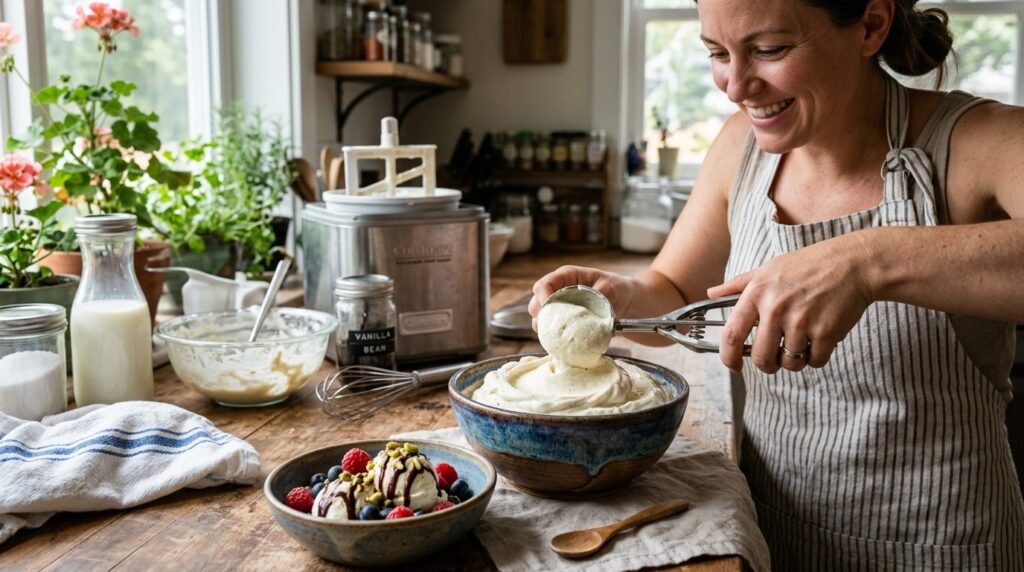
A Few Things Worth Knowing
The custard base must be cold before churning. A warm base takes longer to churn, incorporates less air, and produces a denser, icier texture. Chill it overnight if you can. This step is easy to rush. Don’t.
Press plastic wrap directly against the surface before freezing. Air contact produces ice crystals. The plastic eliminates the air gap. It takes five seconds and matters.
Pull ice cream from the freezer 5 minutes before serving. Home ice cream, without commercial stabilizers, freezes harder than store-bought. A short temper at room temperature produces a scoopable texture without compromising the cold. Longer than 10 minutes and the edges begin to melt unevenly.
Alcohol softens the freeze. The eggnog and salted caramel recipes include small amounts of alcohol or high-sugar content that lower the freezing point slightly. The result is a softer scoop. This is intentional — do not try to correct it by freezing longer.
Toast the nuts before adding them. Raw nuts in ice cream taste flat and can become chewy as they freeze. Toast at 160°C for 8–10 minutes until fragrant. Cool completely before adding. The difference is significant.
Flavor fades slightly in the freezer over time. Salt, acid, and spice are the first to soften. If the base tastes slightly more intense than you want before churning, that is about right. After 3 days in the freezer, it will be balanced.
How to Serve It
Alongside warm desserts — a slice of pie, a brownie, a warm spiced cake: the temperature contrast is the point.
In pre-chilled bowls: a warm bowl softens the ice cream too quickly. Ten minutes in the freezer before plating is enough.
Garnished simply: a single piece of candied pecan, a curl of dark chocolate, a drizzle of the caramel or tahini used in the base. Repetition of an element from inside the ice cream reads as considered.
With a glass of Pedro Ximénez sherry alongside the dark chocolate or salted caramel: the sweetness and dried-fruit depth complement without competing.
With Champagne alongside the cranberry swirl or gingerbread: the acidity and effervescence cut through the fat cleanly.
Worth Noting Nutritionally
These are cream-and-egg-based desserts. A standard 100g serving of custard-based ice cream runs approximately 200–280 calories, depending on mix-ins.
For dairy-free: Replace the custard base with full-fat coconut milk and coconut cream in equal proportion. The flavor is noticeably different — coconut-forward — but the texture is workable. The no-churn recipes can use coconut whipping cream and sweetened condensed coconut milk with similar results.
For lower sugar: Reduce granulated sugar in the custard by up to 30g. Below that, the freezing point is affected and the texture becomes icier. Condensed milk in the no-churn recipes cannot be reduced without structural consequences.
For egg-free: Use the no-churn base for all seven recipes, adding the flavor components from each custard variation to the condensed milk before folding in the cream.
A Few Questions
How far ahead can I make these? All seven recipes keep well for up to 5 days in the freezer with no meaningful quality loss. Beyond that, ice crystals begin to develop and the texture becomes gradually coarser. For a holiday gathering, making 2 to 3 days ahead is the practical window — far enough in advance to remove stress, close enough to serve at peak quality.
Do I need an ice cream machine? Recipes 1 through 5 use a machine and produce a noticeably smoother, lighter result because of the mechanical aeration during churning. Recipes 6 and 7 require no machine — the whipped cream provides the aeration. If you do not own a machine, both no-churn recipes are designed to stand independently as complete, party-worthy desserts.
My custard curdled — can it be saved? Sometimes. If the yolks scrambled due to heat that was too high, pour the mixture immediately into a blender and blend on high for 30 seconds. Strain through a fine-mesh sieve. If the curds are fine, the strained custard may still be smooth enough to use. If the curdling is severe, the texture will not recover and the batch should be restarted. Prevent it by keeping the heat at medium-low and stirring continuously.
Can I make these without a loaf tin for the no-churn versions? Any freezer-safe container with a lid works. A wide, shallow container freezes faster and more evenly than a deep one. Whatever container you use, line it with plastic wrap for clean removal and easy slicing.
Make one. Make three. The freezer handles the rest.