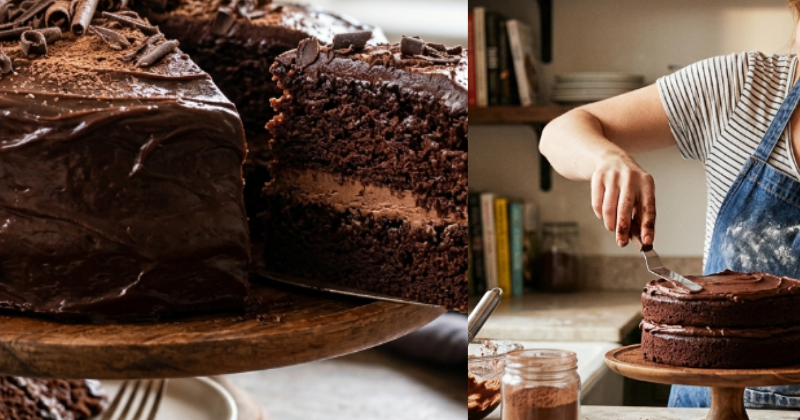
Chocolate cake is not complicated. It is just unforgiving of shortcuts.
These 9 chocolate cake recipes that fail-proof your next party are built around that understanding. Each one has been chosen because it holds up under real conditions — made the day before, transported, served at room temperature, cut by someone who is not paying close attention. They do not require specialty equipment or hard-to-source ingredients. What they require is following the method. Do that, and the results are consistent.
Prep time: 20–30 minutes | Bake time: 25–45 minutes depending on recipe | Total time: 1–2 hours (plus cooling) | Servings: 12–16 per recipe
What Makes It Worth Making
- Most of these recipes are better the day after baking. Make them ahead without apology.
- The base method — creaming, alternating wet and dry, proper oven temperature — applies across all nine. Learn it once.
- Chocolate cake is the one dessert that works at every kind of party, for every kind of crowd, without explanation.
- Nine variations from one core skill set means a different cake for every occasion without starting from zero each time.
The Ingredients
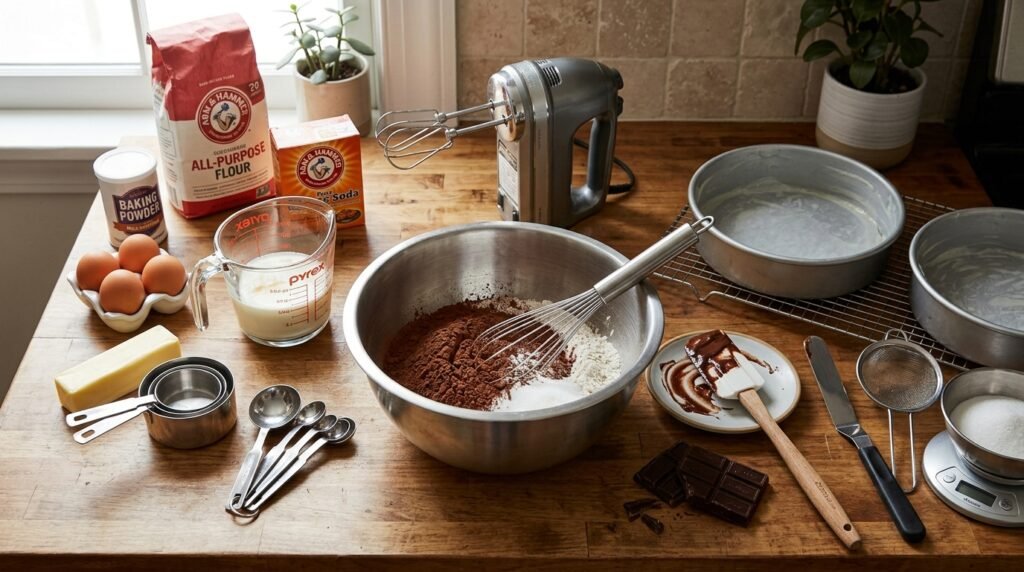
All-purpose flour, 2 cups: Structure. Measured by spooning into the measuring cup and leveling — not scooping directly from the bag, which compacts the flour and produces a drier cake. Substitution: cake flour produces a more tender crumb; use 2 and a quarter cups in place of 2 cups all-purpose.
Dutch-process cocoa powder, three-quarters cup: The chocolate flavor in most of these recipes. Dutch-process is alkalized, which produces a darker color and smoother, less bitter flavor than natural cocoa. They are not interchangeable in recipes that use baking soda — natural cocoa is acidic and reacts with soda; Dutch-process does not. Use what the recipe specifies.
Baking powder and baking soda (amounts vary): Leavening. Both are used in some recipes; only one in others. The combination depends on the acid content of the other ingredients. Do not substitute one for the other.
Fine sea salt, 1 tsp: Flavor amplifier. Salt makes chocolate taste more like chocolate. Under-salted chocolate cake tastes flat. This is always worth checking.
Unsalted butter, 1 cup (2 sticks), room temperature: Fat and structure. Room temperature means it yields to gentle pressure but does not melt on contact. Cold butter does not cream properly. Melted butter produces a different texture entirely — denser and moister, which suits certain recipes in this list deliberately.
Granulated sugar, 2 cups: Sweetness and moisture retention. Sugar is hygroscopic — it pulls moisture from the air and keeps the crumb from drying out. Do not reduce it without understanding this function.
Eggs, 3 large, room temperature: Binding, structure, and lift. Cold eggs can cause the batter to break — the fat and liquid separate rather than emulsify. Leave them out for thirty minutes before baking.
Buttermilk, 1 cup: Acid that reacts with baking soda for lift, and fat that contributes tenderness. Substitution: one cup whole milk plus one tablespoon white vinegar, stirred and left for five minutes. The result is nearly identical.
Hot coffee or hot water, 1 cup: Blooms the cocoa powder, deepening the chocolate flavor. Hot coffee does not make the cake taste like coffee — it makes it taste more like chocolate. Hot water works as a substitution with a minor flavor reduction.
Vanilla extract, 2 tsp: Background depth. It is not detectable as vanilla in a chocolate cake; its absence is detectable as something missing.
Dark chocolate, 70% or higher (for ganache and some batters), 8 oz: Used in the richer recipes and in ganache frosting. Chop it yourself from a bar — chocolate chips contain stabilizers that prevent proper melting and affect ganache texture.
Heavy cream, 1 cup (for ganache): Combined with chopped chocolate in a one-to-one ratio by weight for a pourable ganache. Warmed, not boiled — boiling separates the fat.
How to Make It
These instructions cover the base layer cake method. Variation-specific adjustments follow in the recipe list.
- Preheat the oven to 350°F. Grease and flour two 9-inch round cake pans, or line with parchment circles. Both steps — grease and flour — matter. Parchment alone is insufficient for some batters.
- Whisk dry ingredients together in a medium bowl: flour, cocoa, baking powder, baking soda, salt. Set aside. Whisking rather than sifting is sufficient and distributes the leavening evenly.
- Cream butter and sugar in a large bowl with a hand or stand mixer on medium-high for three to five minutes. The mixture should be pale, fluffy, and noticeably increased in volume. Under-creamed butter and sugar is the most common cause of a dense cake.
- Add eggs one at a time, mixing fully after each addition. Add vanilla. Scrape down the sides of the bowl. The batter should look smooth and cohesive.
- Alternate adding dry ingredients and buttermilk, beginning and ending with dry. Three additions of dry, two of buttermilk. Mix on low after each addition only until just combined. Overmixing at this stage develops gluten and toughens the crumb.
- Add hot coffee last, stirring by hand until fully incorporated. The batter will be thinner than expected. This is correct.
- Divide between prepared pans. Tap each pan firmly on the counter twice to release air bubbles. The batter should be level — use a scale if you want even layers.
- Bake 30–35 minutes, until a toothpick inserted in the center comes out with a few moist crumbs — not wet batter, not completely clean. A completely clean toothpick means the cake is slightly overbaked.
- Cool in pans for 10 minutes, then turn out onto a wire rack. Cool completely before frosting. Frosting a warm cake melts the frosting and causes it to slide. Completely means completely — two hours minimum, or overnight.
The Nine Recipes:
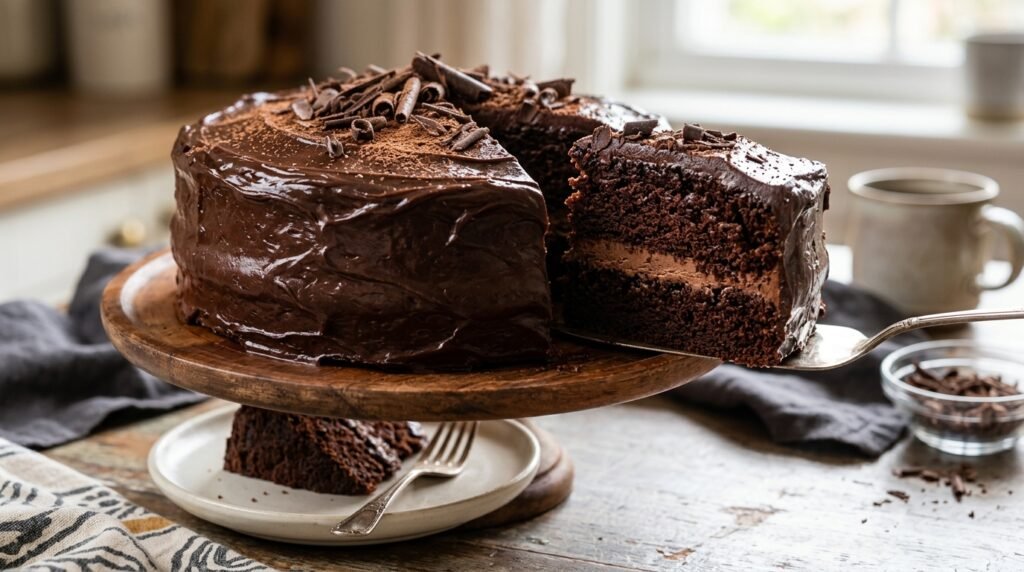
- Classic Chocolate Layer Cake: The base recipe above with chocolate buttercream. The standard by which all others are measured.
- Chocolate Ganache Cake: Same base, finished with poured dark chocolate ganache instead of buttercream. Simpler to execute and more visually striking.
- One-Bowl Chocolate Sheet Cake: All wet ingredients combined first, dry ingredients added once. Baked in a 9×13 pan for 35 minutes. Serves a crowd from a single pan — the most practical party cake here.
- Molten Chocolate Lava Cakes: Individual ramekins, a short bake at high heat, served immediately. The only recipe here that cannot be made ahead. The interior sets within minutes of leaving the oven.
- Flourless Chocolate Torte: Dark chocolate, butter, eggs, sugar, cocoa — no flour. Baked low and slow at 325°F for 25 minutes. Dense, fudgy, naturally gluten-free. Better the next day.
- Chocolate Olive Oil Cake: Olive oil replaces butter entirely. Produces a moist, slightly fruity crumb that improves over two days. The most make-ahead friendly of the nine.
- Chocolate Bundt Cake with Espresso Glaze: The base batter baked in a greased and floured Bundt pan for 45–50 minutes, finished with a simple espresso and powdered sugar glaze. Visually impressive with minimal decoration effort.
- Chocolate Icebox Cake: No baking required. Layers of chocolate wafer cookies and whipped cream assembled in a loaf pan and refrigerated overnight. The cookies soften into a cake-like texture. Built entirely the day before.
- Chocolate Mug Cake: Four tablespoons flour, four tablespoons sugar, two tablespoons cocoa, one egg, three tablespoons milk, three tablespoons oil, small pinch salt. Microwaved three minutes. For the moment when a party is one person and the occasion is a Tuesday.
A Few Things Worth Knowing
The result is better the next day for every recipe here except the lava cakes. Chocolate cake flavor deepens overnight as the cocoa compounds continue to develop. Bake the day before the party without hesitation.
This step is easy to skip. Don’t: cooling completely before frosting. Warm cake melts buttercream on contact and the frosting slides regardless of how carefully it is applied. If you are short on time, twenty minutes in the refrigerator after the cake reaches room temperature accelerates the process.
Measure flour correctly. Spoon it into the measuring cup and level with a straight edge. Scooping compacts the flour by up to thirty percent and produces a drier, denser cake. A kitchen scale eliminates the variable entirely — 240 grams per two cups.
Do not open the oven before the twenty-minute mark. Temperature drops cause the center to collapse before the structure sets. The toothpick test at the suggested time is the right method. Earlier is not more careful; it is counterproductive.
Room temperature ingredients are not optional for creamed cakes. Cold butter does not incorporate air during creaming. Cold eggs break the emulsion. Take both out of the refrigerator thirty minutes before you begin. Set a timer if you need a reminder.
Ganache sets at room temperature and softens with warmth. A poured ganache that has firmed up too much can be gently warmed over a double boiler and re-poured. A ganache that has been refrigerated will need fifteen to twenty minutes at room temperature before it is pourable again. Both situations are recoverable.
How to Serve It
At room temperature. Refrigerated cake is denser and the frosting firms into something less pleasant. Pull it out at least thirty minutes before serving.
Cut with a sharp knife run under hot water and wiped dry between slices. Clean cuts are a presentation detail that costs nothing.
A scoop of vanilla ice cream alongside the flourless torte and the lava cakes — the temperature contrast and the neutral sweetness work against the intensity of both.
Fresh raspberries or a few flakes of sea salt on top of any ganache-finished cake. Both add something without competing.
Drink: coffee alongside any of the denser, richer recipes. A glass of cold whole milk with the sheet cake and the mug cake, which are the most straightforward of the nine. A small pour of something dark — port, amaro, bourbon — with the flourless torte for an evening occasion.
Worth Noting Nutritionally
Chocolate cake is a dessert. Its nutritional value is modest and that is not a problem. Dark chocolate — used in the ganache, the torte, and the lava cakes — contains flavanols associated with cardiovascular benefits in moderate amounts. Cocoa powder contributes iron, magnesium, and antioxidants in quantities that are real if not dramatic at typical serving sizes.
For gluten-free preparation, the flourless torte requires no modification and is the strongest option — it is designed without flour and the texture does not suffer. The remaining recipes can be adapted with a one-to-one gluten-free flour blend; results vary by brand, and the texture will be slightly different.
For dairy-free, replace butter with refined coconut oil in equal measure — it behaves similarly in baking and has a neutral flavor. Replace buttermilk with full-fat oat milk plus one tablespoon apple cider vinegar. Replace heavy cream in ganache with full-fat coconut cream — the ganache sets slightly differently but is fully functional. Use dairy-free dark chocolate, which is widely available in 70% and above.
For egg-free, a flax egg — one tablespoon ground flaxseed plus three tablespoons water, rested five minutes — substitutes in the sheet cake and olive oil cake. The layer cake and torte are more structurally dependent on eggs and do not adapt as cleanly.
A Few Questions
Can I make these cakes ahead and freeze them? Unfrosted cake layers freeze well for up to three months. Wrap each layer tightly in plastic wrap, then in foil. Thaw overnight in the refrigerator still wrapped — this prevents condensation from forming on the surface of the cake. Frost after thawing. Frosted cakes can be frozen but the texture of buttercream changes slightly on thawing; ganache freezes and thaws more cleanly.
My chocolate cake always comes out dry. What is going wrong? The three most common causes are too much flour from scooping rather than spooning, overbaking past the moist-crumb stage, and skipping the hot coffee or water that blooms the cocoa. Address all three simultaneously rather than one at a time. A kitchen scale for the flour and a reliable oven thermometer — many home ovens run hot by 25 degrees or more — solve most dryness problems permanently.
Can I use a different pan size than the recipe specifies? Yes, with adjustments to baking time. Thinner layers in smaller pans bake faster; deeper batter in a larger pan bakes slower. The toothpick test is more reliable than the timer in any pan-size variation. A 9-inch round layer cake recipe baked in a 9×13 sheet pan will take approximately the same total time but should be checked at 25 minutes. A Bundt pan of the same recipe needs 40–50 minutes.
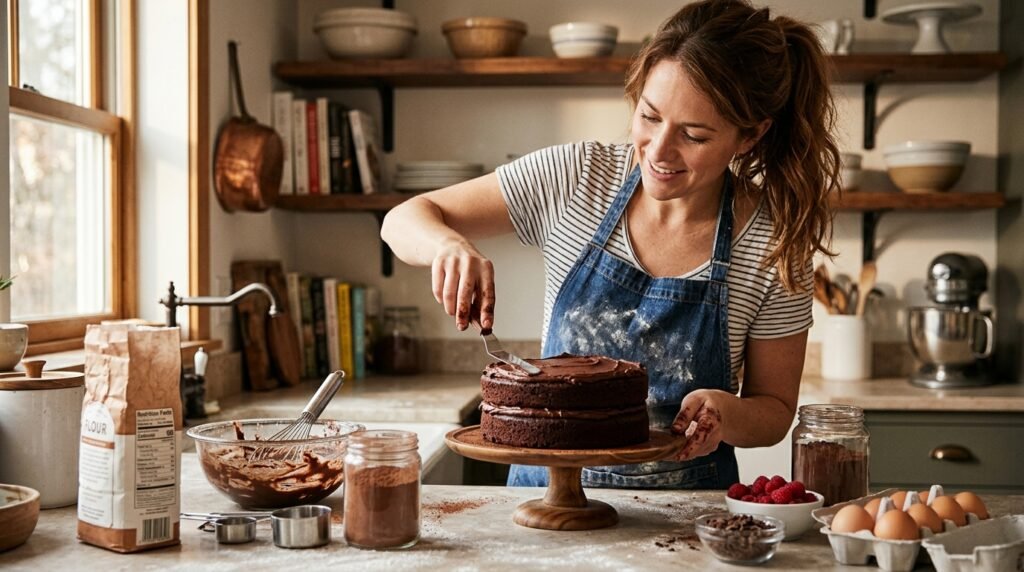
How do I get smooth, professional-looking frosting? A thin crumb coat — a sparse first layer of buttercream applied to trap loose crumbs — chilled for fifteen minutes before the final coat is applied, is the technique used in professional kitchens. An offset spatula produces more control than a straight one. Warming the spatula briefly under hot water produces a smoother final pass. None of this requires special skill — it requires the crumb coat step, which most home bakers skip.
Choose one recipe for the next occasion. Make it the day before. Everything else takes care of itself.